


'%3e%3crect%20width='512'%20height='256'%20fill='%23f0f0f0'/%3e%3crect%20y='256'%20width='512'%20height='256'%20fill='%23d80027'/%3e%3cpath%20d='M0%200%20L256%20256%20L0%20512%20Z'%20fill='%230052b4'/%3e%3c/g%3e%3c/svg%3e)
This term encompasses all aspects of employee health and happiness within the corporate environment. It is not limited to physical aspects but includes mental, emotional, and even spiritual dimensions. It is an integrated approach addressing not only individuals but also the broader context.
What is Workplace Wellbeing
This term encompasses all aspects of employee health and happiness within the corporate environment. It is not limited to physical aspects but includes mental, emotional, and even spiritual dimensions. It is an integrated approach that addresses not only individuals but also the broader context, such as corporate culture, strategy, and leadership.
The 5 Wellbeing Domains Model
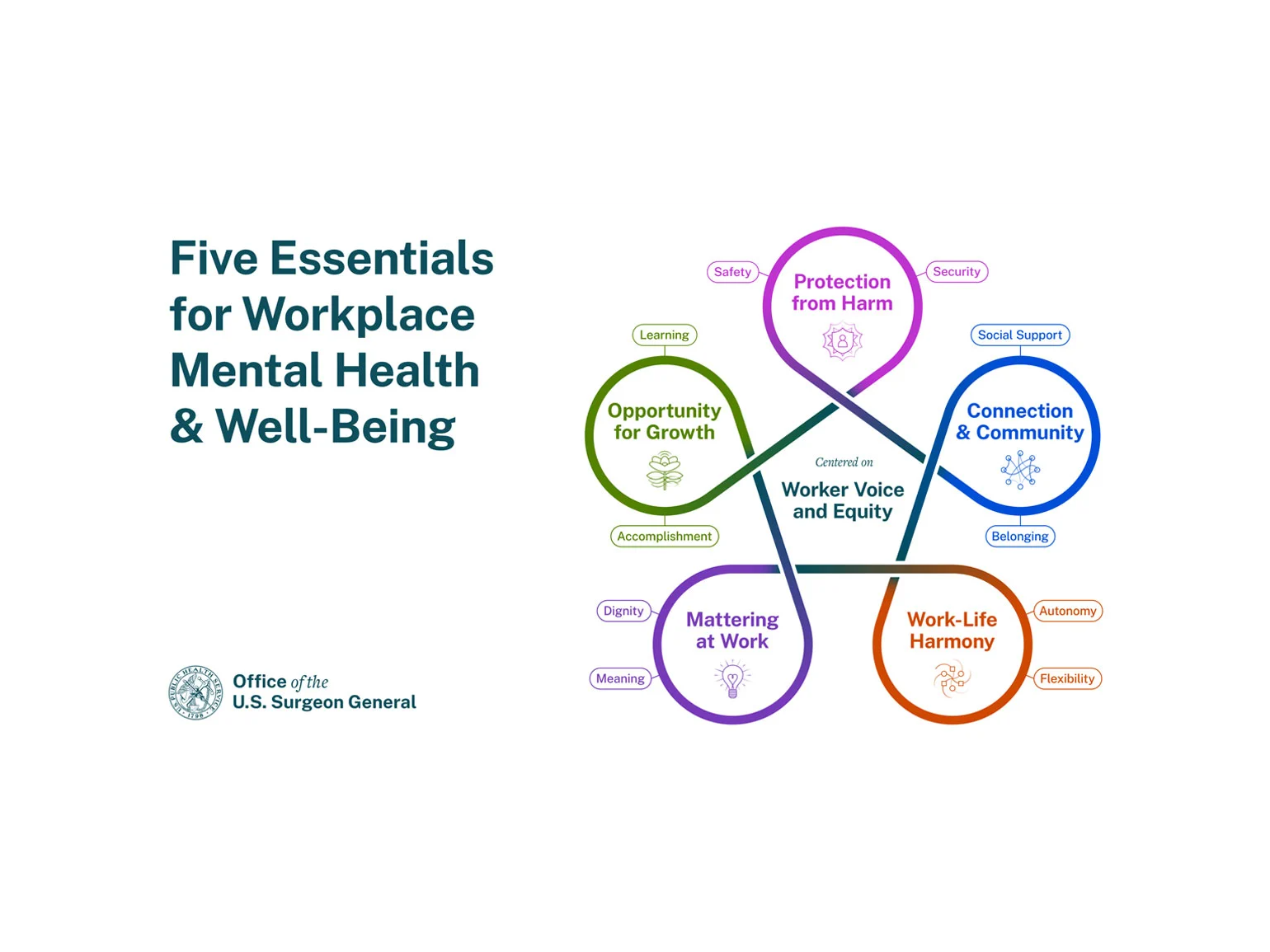
To better illustrate what Workplace Wellbeing entails, the most current model titled "Five Essentials for Workplace Mental Health and Wellbeing" serves as a guide. It offers inspiration in a clear and understandable form. Each of the five domains is linked to two fundamental human needs. Note that the voice and equity of employees are at the center of interest.
- Source — Five Essentials for Workplace Mental Health & Well-Being, Office of the U.S. Surgeon General, https://www.hsph.harvard.edu/population-development/2022/10/20/u-s-surgeon-general-releases-framework-for-workplace-mental-health-and-well-being/ *
Protection from Harm need for safety and security
physical and psychological safety in the work environment comes first, sufficient space and time for adequate rest at the workplace, normalizing and supporting mental health, and incorporating DEI&A (Diversity, Equity, Inclusion & Accessibility) norms and guidelines into company policies.
Connection and Community need for social support and belonging
creating a culture of inclusion and acceptance, cultivating trusted relationships, and strengthening collaboration and teamwork.
Work-Life Harmony need for autonomy and flexibility
providing greater autonomy regarding task completion, creating flexible and predictable work schedules, increasing the availability of paid time off, and respecting boundaries between work and non-work time.
Mattering at Work need for purpose and dignity
providing adequate pay, engaging employees in decisions regarding the work environment, creating a culture of gratitude and appreciation, and connecting individual work with the company's vision and mission.
Opportunity for Growth need for development and achievement
offering training, education, and mentoring; strengthening clear and equitable opportunities for career advancement; and ensuring relevant, two-way, and especially mutual feedback.
What Happens if Wellbeing is Missing at Work?
Among the most common causes of stress and burnout are unfair treatment, excessive workload, unclearly defined employee competencies, lack of communication and support from supervisors, and unrealistic deadlines. These factors can lead to burnout and negatively affect employee health and performance.
How to Achieve Better Workplace Wellbeing?
Every company is unique, with its own priorities, goals, and culture. Therefore, it is impossible to apply universal steps that will automatically lead to improved wellbeing. It is important to start gradually: evaluate available data, collaborate with key stakeholders, and implement changes progressively.
Providing various benefits and programs is only the beginning; however, the true meaning lies in creating an inclusive corporate culture, focusing on meaningful work, strengthening teamwork, and developing individuals.
If you want to support employee satisfaction in other areas as well — for example, through changes in the work environment — let yourself be inspired by the article Destination Office: Create a Place Employees Will Love